







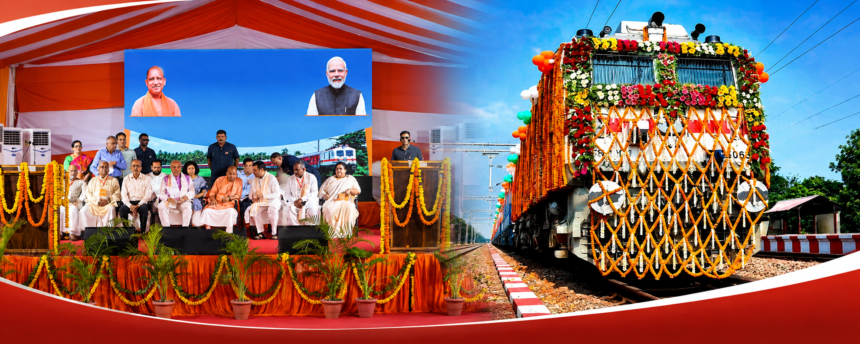
Dang – The newly launched Nepalgunj Road (Rupaidiha)–Varanasi rail service is expected to give fresh momentum to tourism and transportation in the Nepal–India border region. The rail service was formally inaugurated virtually by India’s Minister for Railways, Information and Broadcasting, and Electronics and Information Technology, Ashwini Vaishnaw.
A special ceremony was organized at Nepalgunj Road Railway Station, attended by Uttar Pradesh Chief Minister Yogi Adityanath, Dumariyaganj Member of Parliament Jagdambika Pal, public representatives, officials and workers of the Bharatiya Janata Party, and local residents.
The new rail service has made travel easier from Rupaidiha, which is connected to Nepalgunj, through Nanpara, Risia, Bahraich, Gonda and Gorakhpur to Varanasi. The service came into operation after the approximately 56-kilometre Nepalgunj Road–Bahraich railway section was upgraded to broad gauge. The total rail distance from Nepalgunj Road to Varanasi is approximately 563 kilometres.
Major Boost Expected for Religious Tourism
One of the most significant impacts of the new rail service is expected to be on religious tourism. Varanasi, Ayodhya and Gorakhpur are among India’s major religious and cultural destinations. Easier rail access to these destinations is expected to increase religious travel by Nepali tourists and pilgrims, according to tourism entrepreneurs.
The new rail service will provide greater convenience for travellers from western Nepal visiting religious destinations such as the Kashi Vishwanath Temple and the Ganga Aarti in Varanasi, the Ram Temple in Ayodhya and the Gorakhnath Temple in Gorakhpur. Likewise, the railway connectivity is also expected to make it easier for tourists from various Indian states to enter Nepal through Rupaidiha and travel to tourist destinations across western Nepal.
Expected Increase in Indian Tourists Visiting Nepal
With the rail service expanding connectivity between major Indian cities and Nepalgunj, stakeholders in the tourism sector believe that Nepalgunj now has an opportunity to develop as a major tourism gateway to western Nepal.
After entering Nepal through Rupaidiha, tourists can travel to destinations including the Bageshwori Temple in Banke, Banke National Park, Bardiya National Park, Thakurdwara, various destinations in Karnali Province and the Lumbini region.
In particular, the new rail connectivity could provide significant benefits if Bardiya National Park’s jungle safaris, wildlife viewing, Tharu culture and homestay tourism are effectively promoted among Indian visitors. Tourism entrepreneurs believe that cross-border tourism can be expanded by developing travel packages that connect India’s new rail network with religious and natural destinations located within a short distance of Nepalgunj.
Opportunity to Develop a Rail Tourism Circuit
The new rail service has also created an opportunity to connect destinations such as Varanasi–Gorakhpur–Ayodhya–Nepalgunj–Bardiya–Lumbini into a single tourism circuit.
Religious tourists from India could be brought to Nepal through Nepalgunj and encouraged to visit Bardiya National Park, Lumbini and other tourist destinations. Similarly, tourism packages could be developed to enable Nepali travellers to journey from Rupaidiha to Ayodhya, Gorakhpur and Varanasi.
However, such initiatives will require cooperation among tourism entrepreneurs, hotel operators, travel and tour companies, and relevant government agencies in both Nepal and India.
Impact on Hotels, Transportation and Local Businesses
An increase in tourist arrivals is expected to expand business opportunities for hotels, restaurants, travel agencies, transportation services, tourist guides, handicraft businesses and local producers in Nepalgunj.
Local tourism businesses could benefit directly by encouraging Indian visitors to spend at least one night in Nepalgunj before travelling onward to Bardiya or Lumbini. Separate tourism packages could also be developed for religious travellers. Likewise, Nepali travellers could benefit from organized religious tourism packages focused on destinations such as Varanasi and Ayodhya.
Greater Benefits if Rail Connectivity Extends to Kohalpur
Following the arrival of broad-gauge rail services at Nepalgunj Road, demands have also emerged for extending rail connectivity from Rupaidiha through Nepalgunj to Kohalpur.
Extending railway connectivity to Kohalpur could make it easier to take Indian tourists to more destinations across western Nepal. In particular, it could create greater opportunities to link Bardiya, Surkhet, Karnali and the Lumbini region with the expanding rail network and promote tourism.
Tourism entrepreneurs have stressed that Nepal must also focus on developing integrated tourism packages, facilitating border crossings, improving tourist transportation, establishing information centres and strengthening promotional activities in order to gain maximum benefits from the new rail service.
The Nepalgunj Road–Varanasi rail service is expected to become more than just a means of transportation. It has the potential to serve as an important platform for strengthening cross-border tourism, religious travel, trade and cultural relations between Nepal and India.
If utilized effectively, tourism experts believe the new connectivity could also provide Nepalgunj with a major opportunity to establish itself as a leading tourism hub of western Nepal.




प्रतिक्रिया दिनुहोस्